Agora Crowd Simulation Framework
My PhD flagship — a Unity + Menge framework for authoring crowd behavior visually, built on a stimulus-centric heatmap paradigm with GPU-accelerated simulation.
- Unity 3D
- C#
- Menge
- GPU Compute
- Research
My role
PhD research lead. I designed the heatmap / stimulus-centric paradigm, built the visual behavior-authoring system, and implemented the GPU-accelerated simulation and the image-similarity model-comparison tooling.
Outcome
PhD flagship — published at ACM (IVA 2022) and central to my doctoral dissertation. Validated against real tourist-movement data in Þingvellir National Park, driving up to 3,000 agents at 30–120 FPS.
Crowd simulation is centered around modeling the movements and behaviors of large groups of people. Its importance is evident in domains such as urban planning, safety, and entertainment — areas where virtual agents exhibiting realistic behavior amplify the quality and depth of the simulation.
The challenge
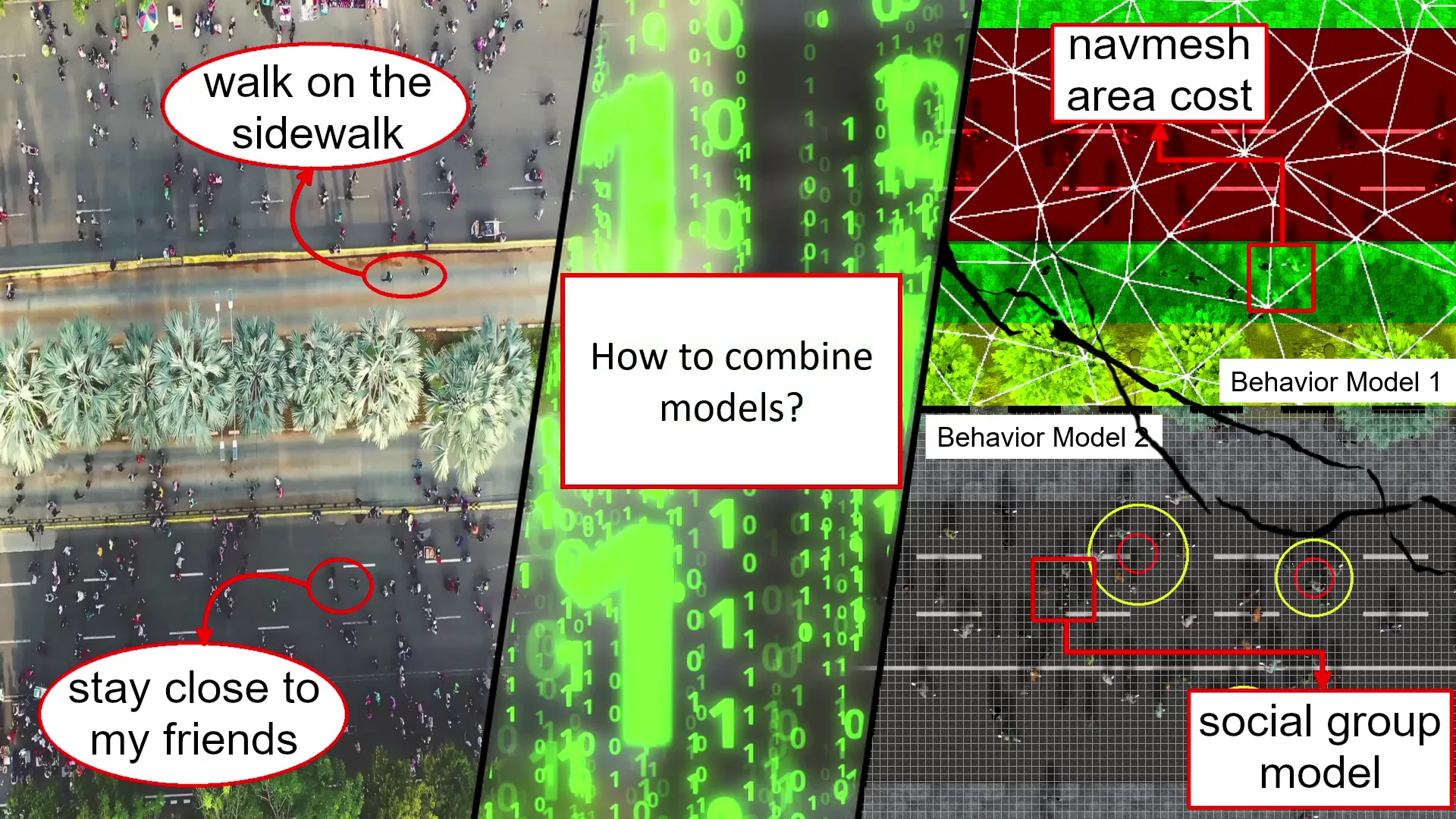
Delving into the intricacies of human behavior poses a distinctive challenge. Traditional computational models, often developed in isolation, are based on varied technology stacks. This makes them not only hard to compare but also difficult to merge. Recognizing this complexity, there emerged a need for an innovative approach.
The solution
Enter the heatmap paradigm. This approach, forming the core of the Agora framework, distills human behavior into fundamental driving stimuli, which are then represented through heatmaps. Agents within the simulation are steered by these heatmaps — gravitating towards attractive areas and avoiding less desirable zones. This shift from a rule-centric to a stimulus-centric approach opens doors to easier comparison and combination of different behaviors. The real strength of the method is its ability to blend different behavior heatmaps through established colour operations.
Architecture and implementation
The innovation extends beyond the conceptual model. Agora is built on a carefully designed modular software architecture that emphasizes the separation of tasks crucial to crowd simulation. Clear boundaries between functions make it adaptable across diverse simulation scenarios. The implementation pairs Unity 3D and Menge: Unity brings its prowess in crafting, editing, and rendering complex environments and characters, while Menge offers a versatile platform for modeling and simulating a spectrum of agent behaviors.
Visual behavior authoring
A major breakthrough is Agora’s visual programming approach to behavior authoring. Users design human-behavior models with visual nodes that can be seamlessly combined, making it possible to merge different behavioral models into comprehensive representations of human behavior.
Key features
- Replaceable components. Built on Menge’s foundation, Agora lets users swap or adjust global and local navigation mechanisms (pathfinding, obstacle avoidance) without exhaustive reworks.
- Versatile crowd generation. Integration with the Unity Multipurpose Avatar (UMA) system permits a diverse array of agents with varying detail, addressing a common limitation of crowd-simulation frameworks.
- Enhanced performance. The heatmap approach runs on GPU compute shaders. Moving heatmap generation off the CPU took the simulation from under 1 FPS to over 30 — enough headroom to update and visualize dynamic heatmaps live while a full crowd runs.
That agent variety and GPU headroom is what makes the simulations feel alive rather than academic — up to 3,000 distinct characters walking believably in real time at 30–120 FPS:
Model comparison
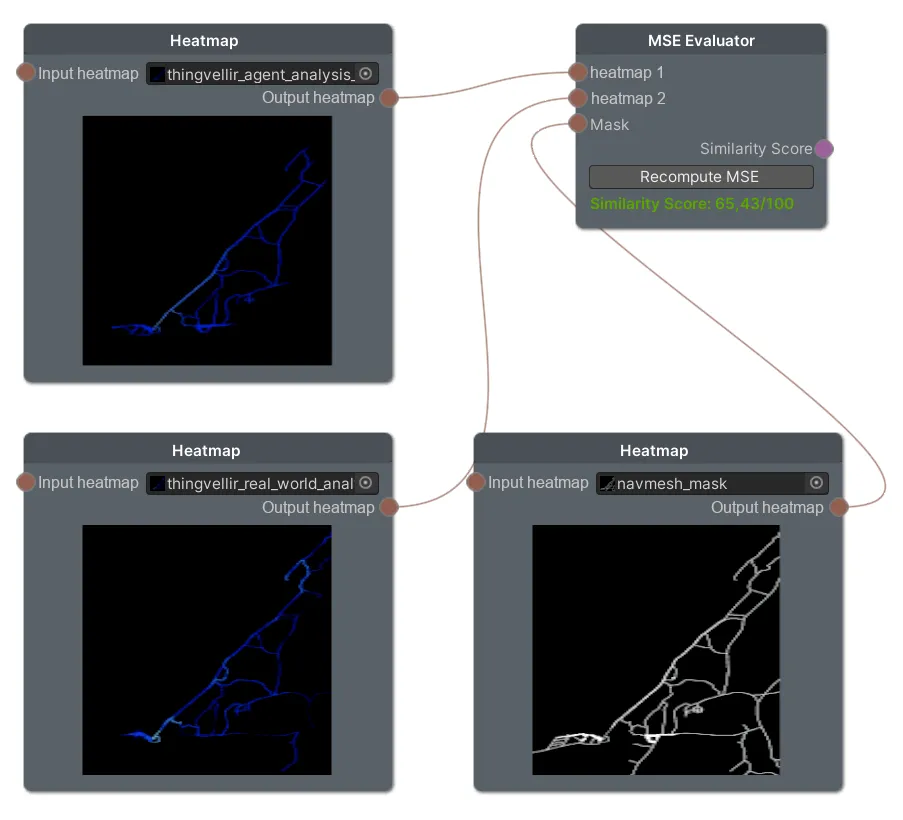
Agora converts real-world data into heatmaps and compares them against simulation output using image-similarity metrics, making model evaluation more streamlined and insightful — offering insight at both low and high levels. In a field study in Þingvellir National Park, Agora reproduced observed tourist-movement patterns as faithfully as a hand-built Unity-native simulation — while being far quicker to author and to compare.
Demo
Want something built like this? I'm available for contract work.