AI Literature Review Assistant
A semi-automatic tool that triages academic papers using Scopus queries and a binary-decision-tree classifier, flagging 'interesting' vs 'not' to speed up literature reviews.
- Python
- Jupyter
- Machine Learning
- Scopus API
My role
Built a semi-automatic literature-triage tool: automated Scopus queries, NLP preprocessing (tokenization, lemmatization, feature extraction), and a binary-decision-tree classifier — optimized in a Jupyter notebook to minimize false negatives — plus a GUI for reviewing titles and abstracts.
Outcome
Reached up to ~85% classification accuracy and saved up to ~15 hours of manual work on the time-intensive first pass over a large corpus of papers.
Links
The AI Literature Review Assistant helps researchers with literature reviews — a crucial but time-intensive step, especially the initial pass over a large corpus of research. Using keyword selection, database search, and machine learning, it automates classifying papers into “interesting” or “not interesting” based on the researcher’s focus. At its core is a binary-decision-tree model, optimized and deployed through a Jupyter notebook.
Features
- Automated paper classification — a binary-decision-tree model categorizes papers against predefined criteria, filtering out irrelevant ones early. Titles are pre-processed (noise removal, tokenization, feature extraction) and lemmatized so the classifier recognizes different forms of the same word.
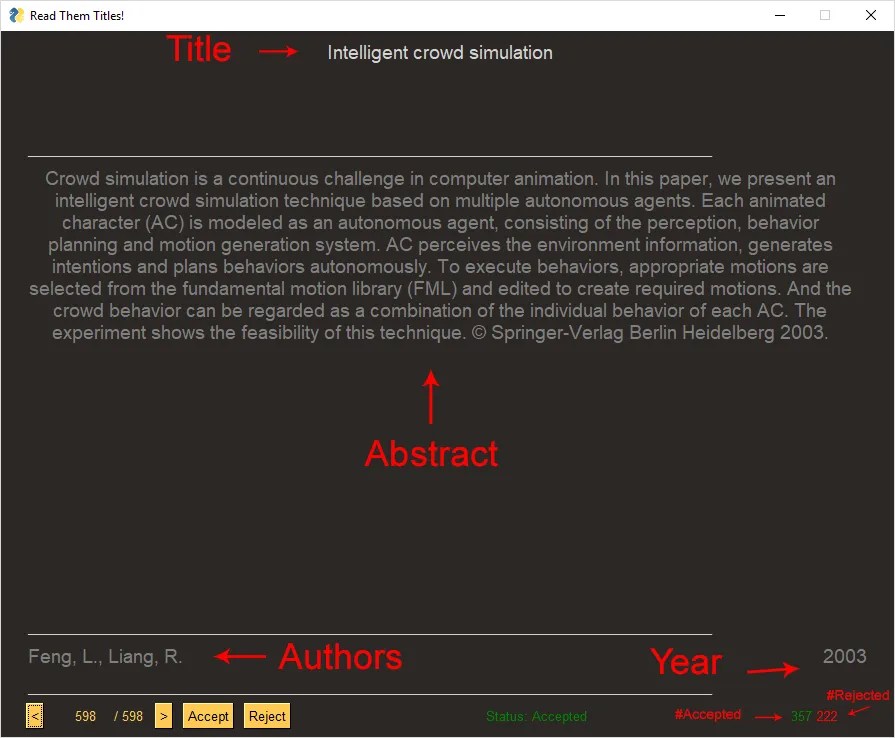
- User-friendly GUI — makes reading and classifying titles and abstracts easy, with simple interactive elements to mark papers “interesting” or “not.”
- Scopus database queries — automates search and retrieval from Scopus, returning titles, authors, and key information for quick relevance assessment.
- Python & Jupyter optimization — a collaborative environment for training, tuning, and deploying the model, using metrics like accuracy, ROC/AUC, recall, and F1 — with tuning aimed at minimizing false negatives for “interesting” titles. In practice it reached up to ~85% accuracy and saved up to ~15 hours of manual triage on a review.
- Keyword extraction & query preparation — helps define keywords and build queries for searching Scopus.
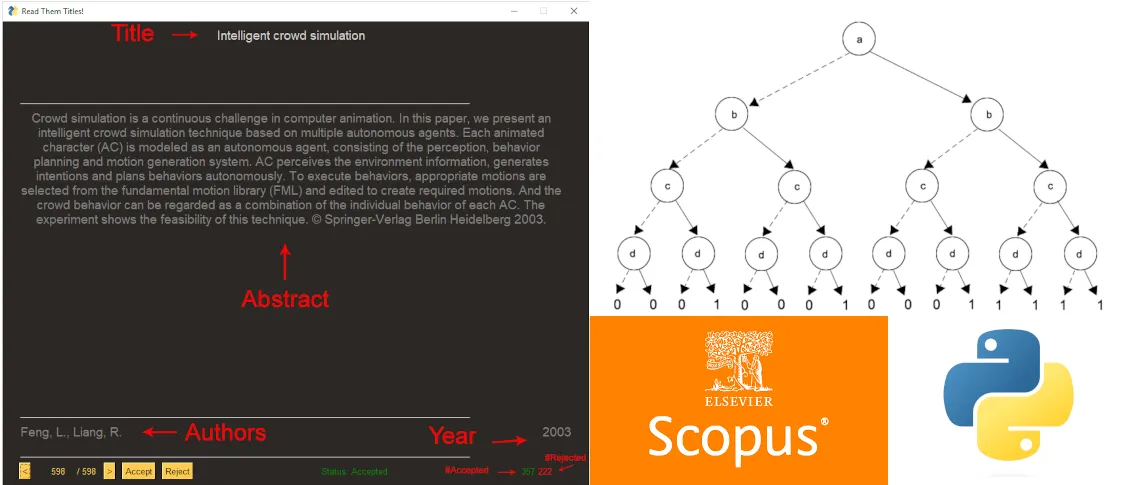
At the heart of the classifier is the binary decision tree — trained on the researcher’s own accept/reject decisions, it learns which title features signal a relevant paper:

The corpus itself comes straight from Scopus: the tool runs the prepared queries and pulls back titles, authors, and metadata ready for triage:

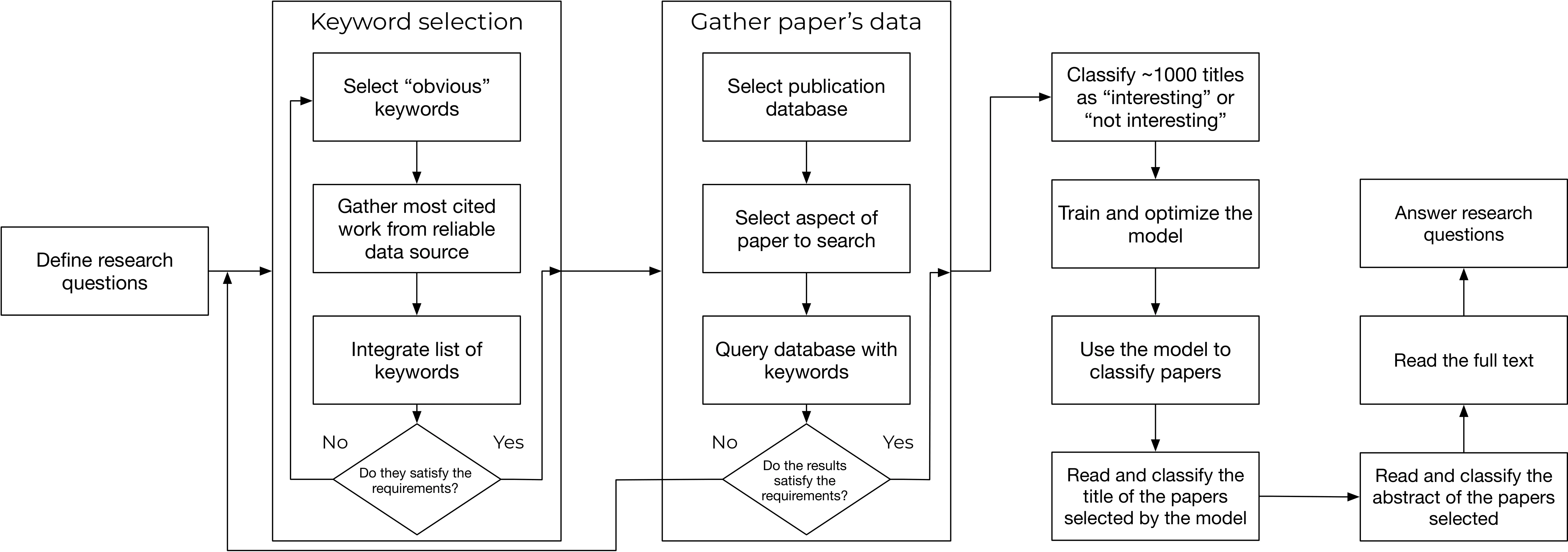
Putting it together, the flowchart below shows how a review unfolds with the tool — from keyword definition through automated triage to the final reading list.
Want something built like this? I'm available for contract work.